

The Defense Team of the “Sacred Struggle” Releases Evidence Exposing a Fabricated Terrorism Case
On April 9, 2026, the preliminary hearings in the “Sacred Struggle” case concluded, and the prosecutors began reading out the identical charges against the 18 defendants as their opening statement. The defense will next deliver its opening statement, after which the evidentiary phase of the trial will commence.
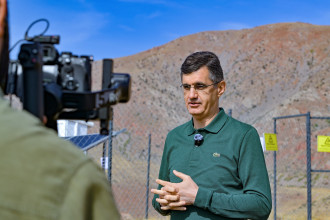
Ahead of this stage, at the initiative of Archbishop Bagrat Galstanyan, a press conference of the defense team was convened to present to the public previously undisclosed evidence in the case—materials that have already been widely used by the authorities in the propaganda sphere.
“First and foremost, this includes the so-called handwritten ‘terrorist plan,’ which has been subjected neither to handwriting examination nor to any reasonable analysis, yet was presented to the public by the head of the Investigative Committee as a document authored by Archbishop Bagrat. Among other things, it contains such absurd ideas as the ‘need to invade an enemy country and take 150,000–250,000 civilians hostage.’ We are publishing this ‘plan’ in English, along with footage of its alleged discovery, allowing the public to judge for itself whether Archbishop Bagrat or any of his associates could have authored such a text,” stated defense attorney Hovhannes Khudoyan.
The defense then released footage from the search of the Archbishop’s residence, showing how colored smoke, paints, a loudspeaker, nails, construction rebar, metal rods, and other household items were seized and presented as tools allegedly intended for terrorist purposes.
Referring to this evidence, defense attorney Tatevik Soghoyan noted:
“We understood, of course, that at the initial stage the prosecution would rely on the mystique of investigative secrecy, and later on the fact that the case was still in the preliminary hearings phase. Therefore, we chose to disclose these so-called ‘evidentiary materials’ ahead of the main hearings to once again demonstrate that this case has no connection to law. This is perhaps the first accusation in the world of preparing terrorism using household items, constructed exclusively through unlawful wiretapping and the distortion of its content. Why unlawful? Because even now in court, prosecutors have refused to present the data on the basis of which these wiretaps were initiated in the first place.”
The attorneys further announced that the refusal to initiate criminal proceedings concerning the falsification of transcripts of the recordings has been appealed before the Anti-Corruption Court. The public will be informed of the results in due course.
The speakers also addressed the progress of related civil cases, expressing the view that political pressure and double standards have also permeated that segment of the judiciary.
“It is regrettable to observe that although officials and pro-government propagandists frequently state in court that by publicly using labels such as ‘terrorist’ they did not specifically refer to the Archbishop Bagrat, or attempt to frame their offensive remarks within the bounds of political speech, the courts lack the courage to properly assess this phenomenon—to recognize defamation, insult, and violations of the presumption of innocence,” attorney Khudoyan stated.
It should be recalled that arrests in the “Sacred Struggle” case began on June 25, 2025, on what the defense describes as fabricated charges of terrorism and preparation to seize power. Following prolonged detention, the preventive measures for most of the 18 defendants have been changed to alternative measures. Currently under house arrest are National Assembly deputy Arthur Sargsyan, his driver Karo Okumushyan, member of the ARF Supreme Body Igor Sargsyan, and activist Vahagn Chakhalyan, while Archbishop Bagrat remains in detention. His position regarding any change of preventive measure is that intermediate forms of restraint are not acceptable.